Think about the last time someone yelled at you. Did it make you feel motivated? Did it make you feel loved? Or did it simply make you want to get away?
If a yell doesn’t work for your adult brain, why are we using it to build our children’s minds? Many of us want our children to listen to us always, but have we ever paused to think: Why do we want them to listen to us instead of us listening to them?
Before we dive into the science, you might want to catch up on my previous post, where I discuss the foundations of our journey: Read my previous post here.
1. The Mirror Test: Why do we yell?
If it is not working for us as human beings, why do we think it will work for kids? We often demand that our children “listen to us” all the time, but we rarely stop to listen to them. Why do we want to fill their growing minds with this kind of behaviour? For a temporary moment, you may have control, but the long-term consequences are a heavy price to pay.
2. The Science: A Brain Under Siege
Scientifically, yelling does more than just hurt feelings—it causes “invisible damage” to a brain in its most critical stage of development.
The Poisoned Nervous System: When we yell, the child’s body is flooded with cortisol (the stress hormone). This literally poisons their sense of safety and puts their nervous system in a state of “fight or flight.”
Cognitive Stunting: A frightened brain cannot learn. Constant yelling can actually slow down a child’s mental power and cognitive development.
Generational Damage: By yelling, we are “seeding” this behaviour in them. They learn that yelling is how you control others, and they will eventually pass this cycle to their own children, spoiling the peace of future generations.
3. The Vedic Root: Krodha and Vāksiddhi
Our ancient scriptures offer profound warnings about anger. In the Bhagavad Gita (2.63), it is said:
krodhād bhavati sammohaḥ sammohāt smṛiti-vibhramaḥ…
“From anger comes delusion, which leads to loss of memory. When memory is lost, the intellect (Buddhi) is destroyed.”
When we yell, we destroy the child’s Buddhi (intellect). We are not teaching; we are creating a “cloud of delusion” where no real learning can happen.
Furthermore, we must respect Vāksiddhi—the purity of speech. Our words are sacred. Our voice should be a “Mantra” that gives our children strength, not a weapon that burns their spirit. When we yell, we waste the spiritual energy of our own voice.
4. The Puranic Mirror: From “Ugra” to “Guru”
In the Puranas, we see the difference between Ugra (fierce, destructive energy) and Shanta (peaceful, guiding energy). When we react with sudden rage, we are acting out of our lower impulses. As parents, we are the first “Gurus” our children ever meet. A true Guru guides with the light of knowledge, not the heat of a curse.
5. Personal Pivot: The “Stranger” in the Room
I used to yell, too—influenced by old habits and the society around me. But everything changed when I looked at my daughters’ faces during those moments.
The warmth in their eyes vanished. They didn’t see their father; they looked at me as if I were a complete stranger—a fierce figure they needed to hide from. I realised then that I wasn’t teaching them respect; I was teaching them terror. I realised that a child’s mind is a temple, and I was entering it with fire.
6. The Practice: The Sadhana of the “Pause”
Changing this habit is a Sadhana (a spiritual practice). It does not happen overnight, but through conscious effort:
The Sacred Pause: When the old habit of yelling rises, I force myself to pause. That one breath is the difference between a reaction and a response.
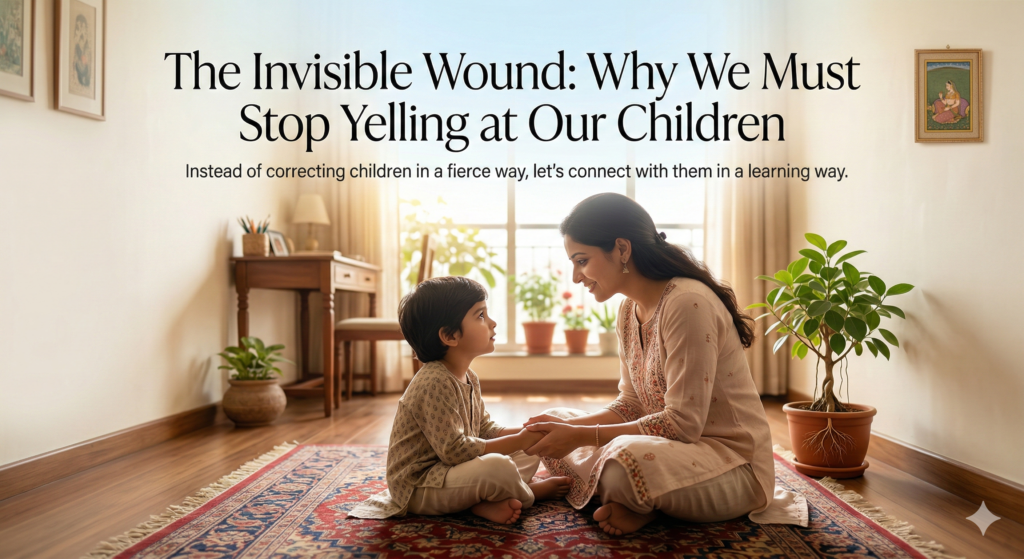
Teaching over Controlling: Instead of demanding they listen, I try to understand why they aren’t. I stop to teach, to explain, and to make them understand the “correct way” with patience.
7. Conclusion: Join the Journey
We want our children to grow up with pure minds, critical thinking, and deep sensitivity. We cannot plant seeds of anger and expect to harvest a crop of peace. Understanding the problem is the first step; practising the “pause” is the second.
What is your experience with the “Pause”? In my next blog, I will share a step-by-step guide on how to teach ourselves the art of patience so we can truly guide our children. Let’s raise roots that are strong, deep, and healthy.
Growing with you,
Satish


Annayya ….
Yes you are correct Annayya,most of the time if kids not listing to us definitely first we shout to them, because of this they became to listing while shouting.
After reading your post I am also trying very hard to control my anger and in calm and peaceful manner now I am teaching to her.
Her behaviour also changing slowly…i hope to continue like this, with out losing control on my behaviour…
Thank you so much for your wonderful 😊 thought ….
Tanujasurya