


In many Indian homes, spirituality begins early.
A child watches their parents light a lamp every morning. They hear prayers being chanted. They accompany grandparents to temples. They learn to fold their hands before a deity even before they fully understand why.
Yet, if we ask children a simple question—
“Why do we pray?”
Many answers sound surprisingly similar:
- “To get good marks.”
- “So God will help me win.”
- “So my wish comes true.”
As parents, we rarely teach this directly. Yet somewhere along the way, children begin to see prayer as a transaction.
Ask. Receive.
Pray. Get rewarded.
But is that really what our spiritual traditions intended?
If we want our children to inherit not only rituals but also wisdom, we need to help them understand the deeper purpose behind prayer, devotion, and God.
The Problem with Treating God Like a Wish-Fulfilling Machine
Imagine a child praying sincerely before an exam.
They pray every day.
They visit the temple.
They avoid distractions.
Yet the result is disappointing.
What happens next?
The child may begin to think:
“I prayed. Why didn’t God help me?”
When spirituality is taught only as a reward system, faith becomes fragile. The moment expectations are not met, disappointment follows.
Many adults carry similar beliefs into later life.
They pray when things go wrong.
They become distant when life becomes difficult.
Their relationship with God becomes dependent on outcomes.
But our ancient traditions teach something far deeper.
Prayer was never meant to guarantee results.
It was meant to prepare us for life.
A Lesson from the Bhagavad Gita
One of the most profound teachings from the Bhagavad Gita comes from the battlefield of Kurukshetra.
When Arjuna stood confused, afraid, and emotionally overwhelmed, Krishna did not promise him victory immediately.
He did not say:
“Do this prayer, and everything will be fine.”
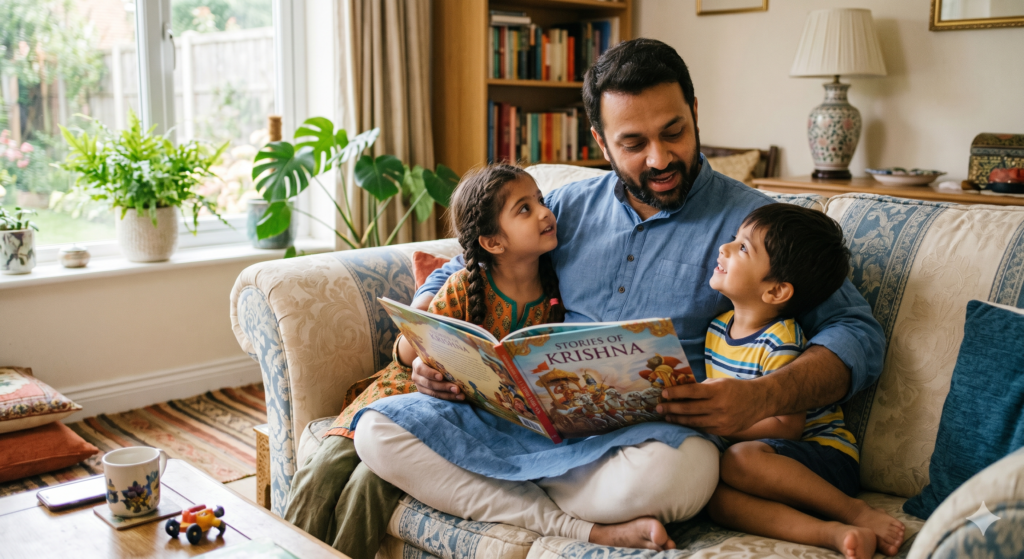
Instead, Krishna transformed Arjuna’s understanding.
The conversation was not about changing circumstances.
It was about changing consciousness.
| Life Element | The Impact of the Conversation |
| Arjuna’s external problem | Remained the same. |
| The battlefield | Remained. |
| The challenges | Remained. |
| But Arjuna himself | Changed. |
| His clarity | Changed. |
| His courage | Changed. |
| His perspective | Changed. |
This is perhaps one of the greatest lessons we can teach our children:
Spirituality is not about controlling life.
It is about preparing ourselves to face life.
Prayer Changes Us Before It Changes Anything Else
When children are young, they naturally look for immediate results.
That’s normal.
But as parents, we can gently help them see prayer differently.
Prayer is not a tool to convince God.
Prayer is a tool to center ourselves.
Think of it this way:
When a child is anxious before an exam, prayer may not change the question paper.
But it can calm their mind.
When a child faces failure, prayer may not erase the disappointment.
But it can give them strength to recover.
When a child feels lonely, prayer may not instantly solve the situation.
But it can remind them that they are supported by something larger than their fears.
The true power of prayer lies in the transformation it creates within us.
Explaining God Through a Simple Analogy
Children understand stories and analogies better than philosophical concepts.
One way to explain spirituality is through music.
Imagine a small violin trying to play along with a large orchestra.
If the violin is out of tune, the sound feels uncomfortable.
But once it is tuned correctly, it naturally blends with the harmony around it.
Our minds are similar.
Every day, we experience stress, anger, jealousy, fear, and confusion.
Prayer, meditation, chanting, gratitude, and reflection help us tune ourselves.
Not because God needs our prayers.
But because we need balance.
We need clarity.
We need inner stability.
Spiritual practices help us return to that alignment.
The Ancient Idea of Pindandam and Brahmandam
Indian wisdom traditions describe a beautiful relationship between the individual and the universe.
They use the terms:
- Pindandam — the individual self.
- Brahmandam — the larger universe.
The idea is simple.
We are not separate from existence.
We are connected to it.
Just as a drop belongs to the ocean, each individual is connected to a larger reality.
Children may not understand these Sanskrit terms immediately, but they can understand the feeling behind them.
When we sit quietly.
When we observe nature.
When we feel gratitude.
When we help another person.
We experience that connection.
Spirituality helps us remember that we are part of something much bigger than ourselves.
What Children Need More Than Success
Modern parenting often focuses on achievement.
Good marks.
Good colleges.
Good careers.
These things certainly matter.
But life eventually presents challenges that cannot be solved through intelligence alone.
Failure.
Loss.
Rejection.
Uncertainty.
These experiences require emotional strength.
A healthy spiritual foundation helps children develop:
- Confidence: The confidence to try again after failure.
- Resilience: The ability to recover from setbacks.
- Gratitude: The habit of appreciating what they already have.
- Compassion: The ability to care about others.
- Inner Peace: The capacity to remain calm even when life becomes uncertain.
These qualities often matter more than achievements themselves.
Turning Rituals into Conversations
One of the biggest mistakes we make as parents is performing rituals without explaining their meaning.
Children imitate first.
But eventually, they begin to question.
And that is a good thing.
Questions are signs of growth.

The next time you perform a ritual, try explaining its symbolism.
- When lighting an incense stick, you might say: “Just as this fragrance spreads in every direction, our kindness should spread wherever we go.”
- When lighting a lamp, you might say: “This light reminds us to remove ignorance and bring clarity into our minds.”
- When breaking a coconut, you might say: “The hard shell represents our ego. The pure white inside reminds us of the goodness within us.”
Suddenly, rituals become meaningful life lessons rather than repetitive actions.
Raising Spiritually Strong Children in a Modern World
Today’s children are growing up in a world filled with information but often lacking reflection.
They are connected to thousands of people online, but sometimes feel disconnected from themselves.
More than ever, they need practices that help them pause.
Reflect.
Observe.
And understand themselves.
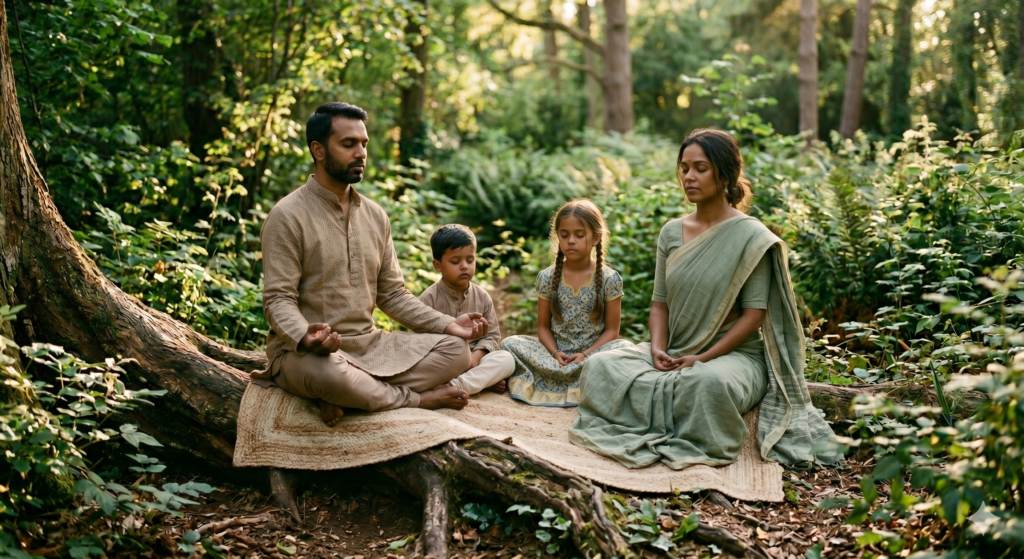
This is where spirituality becomes valuable—not as a set of rules, but as a path toward self-awareness.
The goal is not to make children fearful of God.
The goal is not blind belief.
The goal is to help them discover strength, wisdom, compassion, and peace within themselves.
The Raising Roots Reflection
The next time your child stands beside you during prayer, remember that they are watching far more than the ritual itself.
They are observing your relationship with life.
Your patience.
Your gratitude.
Your humility.
Your faith during difficult times.
Children learn spirituality less from what we preach and more from what we practice.
Let us raise children who understand that prayer is not about getting everything they want.
It is about becoming the kind of person who can handle whatever life brings.
Because the greatest gift spirituality offers is not success.
It is inner strength.
And that is a gift that lasts a lifetime.
How do you explain God, prayer, or rituals to your children? Share your thoughts in the comments—your experience may help another parent on the same journey.