Indian Parenting

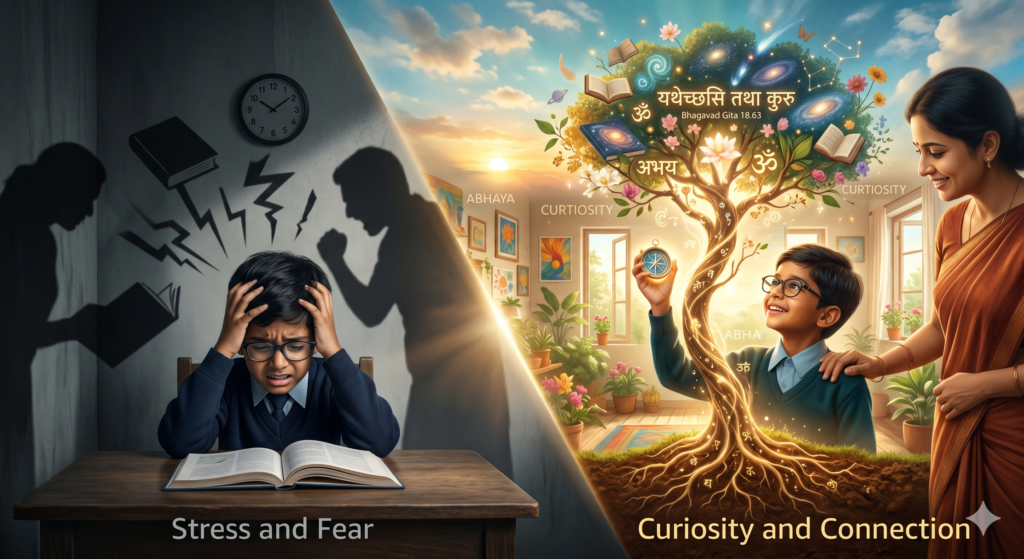
A split illustration showing a child stressed under pressure on the left, and a child learning joyfully under a glowing tree with a supportive parent on the right.

When Fear Steps In, Learning Steps Out: Why Pressure Shapes Compliance More Than Curiosity

When fear steps in, true learning steps out. When we pressure children to learn through stress, their brains shift from curiosity to survival mode, training them to be blind followers rather than independent thinkers. Discover how shifting from “correction to connection” and embracing the ancient Indian wisdom of Abhaya (fearlessness) can set your child’s spirit free to innovate, question, and grow.

When Fear Steps In, Learning Steps Out: Why Pressure Shapes Compliance More Than Curiosity Read More »

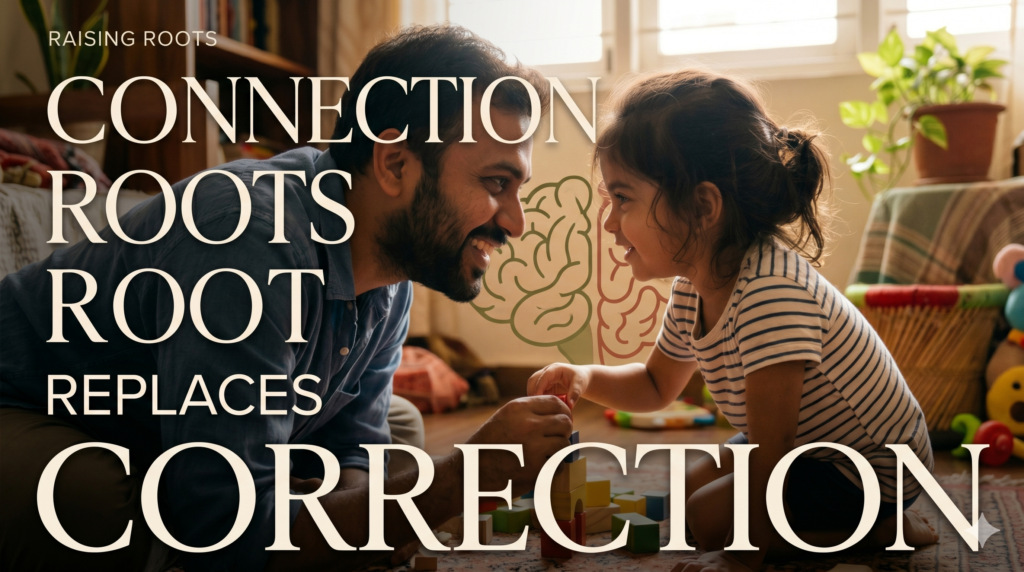
A conceptual parenting image showing a father kneeling to connect with his young daughter. Overlaid are two brain diagrams: one in green labeled "Prefrontal Cortex" (Connection) and one in red labeled "Amygdala" (Correction), with text that reads "Connection Roots Root Replaces CORRECTION."

Why “Not Listening” is Actually a Connection Gap

Is your child really “not listening,” or are you just speaking a language their brain isn’t ready to process yet? Stop the battle of wills and discover why true discipline starts with a view from the floor. Grounded in ancient wisdom and modern neuroscience, learn the one shift that will reduce your parenting frustration by 50% instantly.

Why “Not Listening” is Actually a Connection Gap Read More »

Indian joint family vs modern child using smartphone showing loss of parenting wisdom

The Vanishing Village: Why Modern Parents Are “Orphans” of Wisdom

Modern parenting has more information than ever, but less wisdom. As we move away from joint families and lived experiences, are we unknowingly raising children without roots? This article explores the silent shift and how we can bring back emotional strength, connection, and real guidance into our children’s lives.

The Vanishing Village: Why Modern Parents Are “Orphans” of Wisdom Read More »

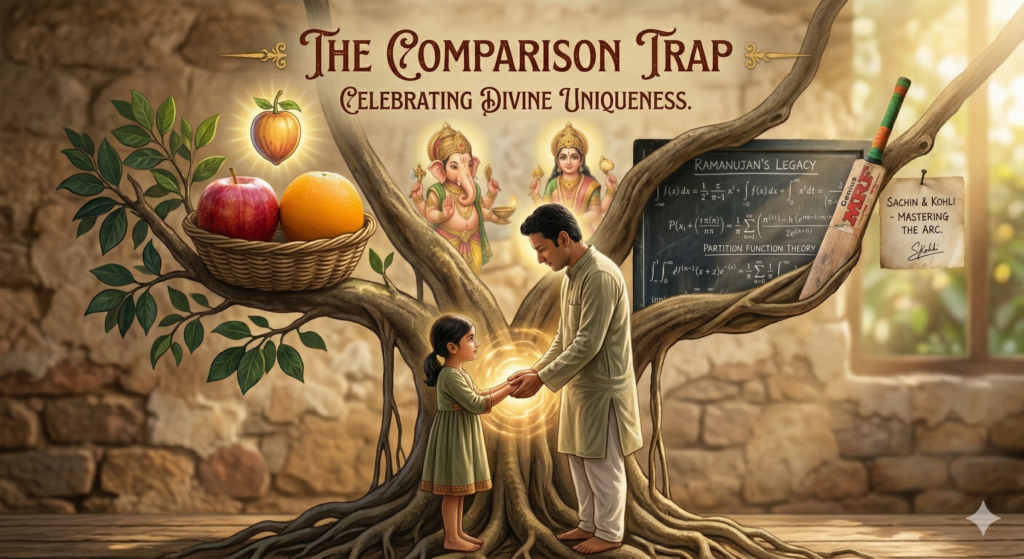
A conceptual illustration of a father and daughter connecting under a large "Raising Roots" tree, featuring symbols of unique talent like an apple and orange, a cricket bat, and mathematical equations.

The Comparison Trap: Celebrating Your Child’s Unique Roots

“If you judge an orange for not being an apple, you’ll call it a failure. Yet, we do this to our children every day. From the wisdom of the Puranas to the brilliance of Ramanujan, discover why the ‘Comparison Trap’ is ruining our children’s cognitive growth—and how you can reconnect with their unique, divine potential.”

The Comparison Trap: Celebrating Your Child’s Unique Roots Read More »

Close-up birds-eye view of a brown bird perched on a tree branch in natural sunlight

The Activity Trap: Are We Developing Children… or Just Distracting Them?

“Every evening, a silent race begins. We move our children from student to athlete to artist—eventually ending in exhaustion. We call it ‘enrichment,’ but are we developing them or just training them for distraction?

Drawing from my own ‘Master of None’ childhood and the ancient wisdom of Arjuna’s one-pointed focus, I share why I’m finally telling my daughter ‘No’ to the shuffle. It’s time we stop filling their schedules and start helping them find their ‘Bird’s Eye.’ Because childhood is not a race to be won; it is a journey to be discovered.”

The Activity Trap: Are We Developing Children… or Just Distracting Them? Read More »

gemini generated image n4xyehn4xyehn4xy

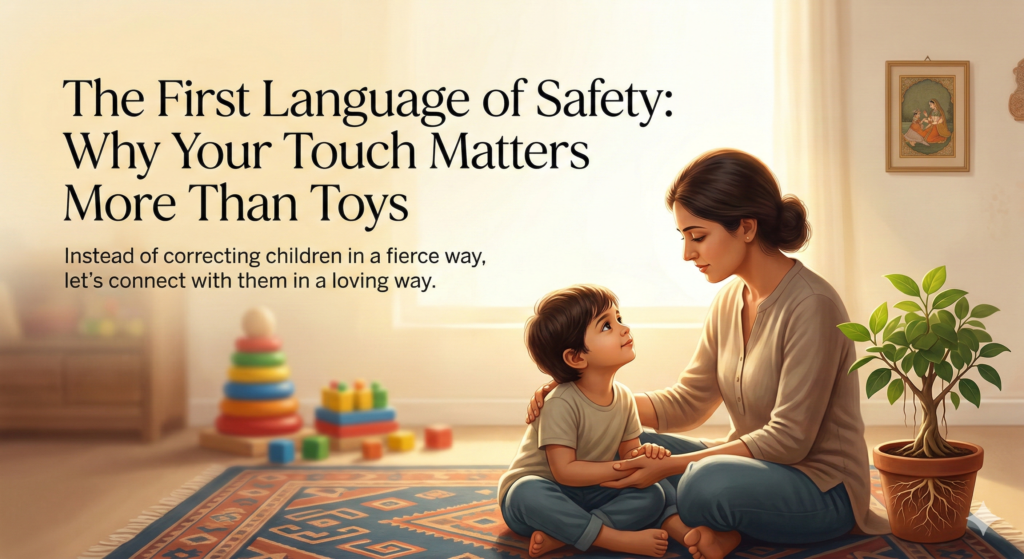
The First Language of Safety: Why Your Touch Matters More Than Toys

“In a world obsessed with ‘smart’ toys and developmental apps, we’ve forgotten the most vital tool in a child’s growth: Physical Connection. Long before a child understands a language or a puzzle, they understand the language of safety through touch. Explore how the Vedic concept of Sparsha and the biological power of oxytocin build a foundation of resilience that no toy can replace. Learn to move from fierce correction to soulful connection.”

The First Language of Safety: Why Your Touch Matters More Than Toys Read More »