
Think about the last time someone stood over your shoulder while you were trying to complete a difficult task.
Perhaps they kept reminding you to hurry.
Perhaps they watched impatiently, correcting every move.
Perhaps their tone carried pressure rather than trust.
What happened inside your mind in that moment?
Did creativity suddenly bloom?
Did curiosity expand?
Did you feel inspired to explore better solutions?
Most likely, no.
Instead, your attention narrowed. Your thoughts became occupied with one goal: “How do I finish this and make this pressure stop?”
This is not weakness. It is simply how human beings respond to stress.
When we experience intense pressure or fear, the brain shifts toward survival responses. In those moments, reflection, curiosity, and deeper learning become harder to access. Rather than exploring and understanding, we begin looking for the quickest path to safety and approval.
Now pause and ask:
What happens when children experience this pressure repeatedly—while studying, reading, taking exams, or trying to meet adult expectations?
Are they truly learning?
Or are they simply learning how to avoid disappointment?
The Silent Shift: From Curious Thinkers to Approval Seekers
Children are naturally wired to explore.
They ask endless questions.
They touch, test, imagine, and wonder.
But when learning becomes associated with fear, criticism, or constant pressure, something subtle begins to change.
The child gradually stops asking:
“Why?”
and begins asking:
“What should I do so I don’t get scolded?”
This shift may not be visible immediately.
The child may still perform well.
They may score marks.
They may appear obedient.
But internally, learning can slowly move from curiosity to compliance.
When approval becomes more important than understanding, children may grow overly dependent on external validation. They may hesitate to make independent choices and look outward for direction instead of developing confidence in their own judgment.
The real concern is not temporary obedience.
The deeper concern is what repeated fear teaches the developing mind about learning, authority, and self-worth.
Fear and Learning: Ancient Wisdom Saw This Long Ago
Long before modern psychology studied stress and learning, Indian wisdom traditions understood the relationship between fear and consciousness.
Our scriptures often speak of two inner states:
Bhaya — fear
and
Abhaya — fearlessness.
True learning, reflection, and wisdom flourish only in the space of Abhaya.
Fear contracts the mind.
Fear narrows perception.
When the intellect (Buddhi) is clouded by anxiety, our power of discrimination (Viveka) weakens. We react quickly, but we do not always understand deeply.
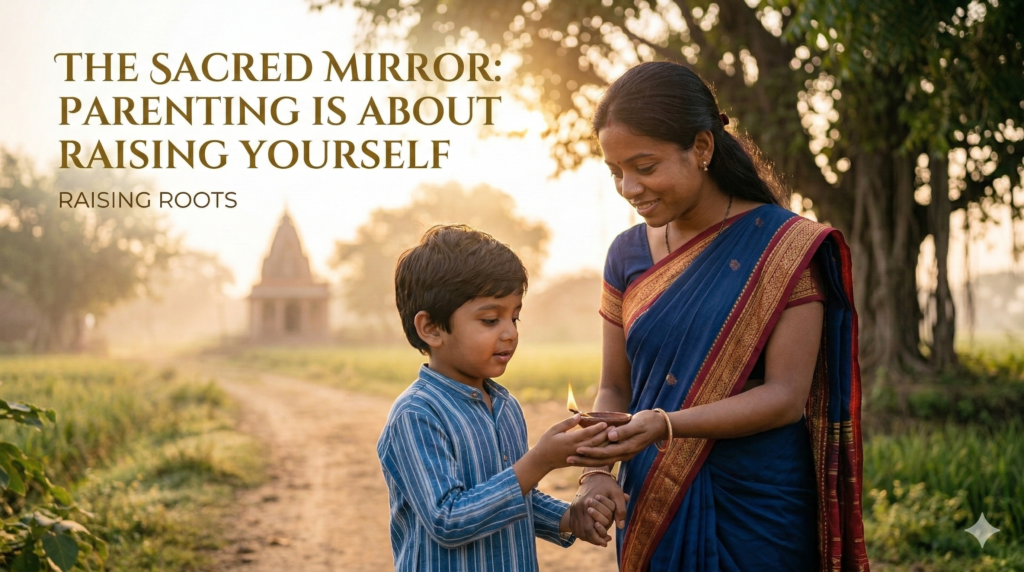
This wisdom appears beautifully in the relationship between guru and disciple.
Consider the dialogue of the Bhagavad Gita.
Arjuna stands on the battlefield, overwhelmed, confused, anxious, and emotionally shaken.
What does Sri Krishna do?
Does he shame him?
Does he threaten him?
Does he demand blind obedience?
No.
Krishna first creates emotional space.
He listens.
He guides.
He helps Arjuna examine his confusion.
And after sharing profound wisdom, Krishna leaves the final choice with him.
“Yathechchasi Tatha Kuru”
(Bhagavad Gita 18.63)
“Reflect deeply upon this, and then act as you choose.”
What a powerful lesson for parenting.
Even the Supreme Teacher does not force understanding.
He offers wisdom, clarity, and trust.
Because learning forced through fear may create obedience, but rarely creates wisdom.
Fearlessness Does Not Mean Lack of Discipline
At this point, an important clarification is needed.
Fear-free parenting does not mean the absence of boundaries.
Children need guidance.
They need routines.
They need accountability and a healthy structure.
But there is a profound difference between:
discipline rooted in connection
and
discipline rooted in fear.
One builds responsibility.
The other builds anxiety.
One teaches self-regulation.
The other teaches avoidance.
The goal is not to remove guidance from parenting.
The goal is to remove fear from guidance.
A Small Everyday Example
Consider homework time.
Pressure-Based Approach
“Finish this now! Why are you always distracted? If you don’t complete it, no TV.”
The child may obey.
But internally, the brain often becomes occupied with escaping pressure rather than engaging with learning.
Now consider another possibility.
Connection-Based Approach
“You seem tired today. Shall we take a small break and then finish this together?”
Notice the difference.
The expectation remains.
The boundary still exists.
But emotional safety changes the experience.
Connection does not weaken discipline.
Often, it makes discipline sustainable.
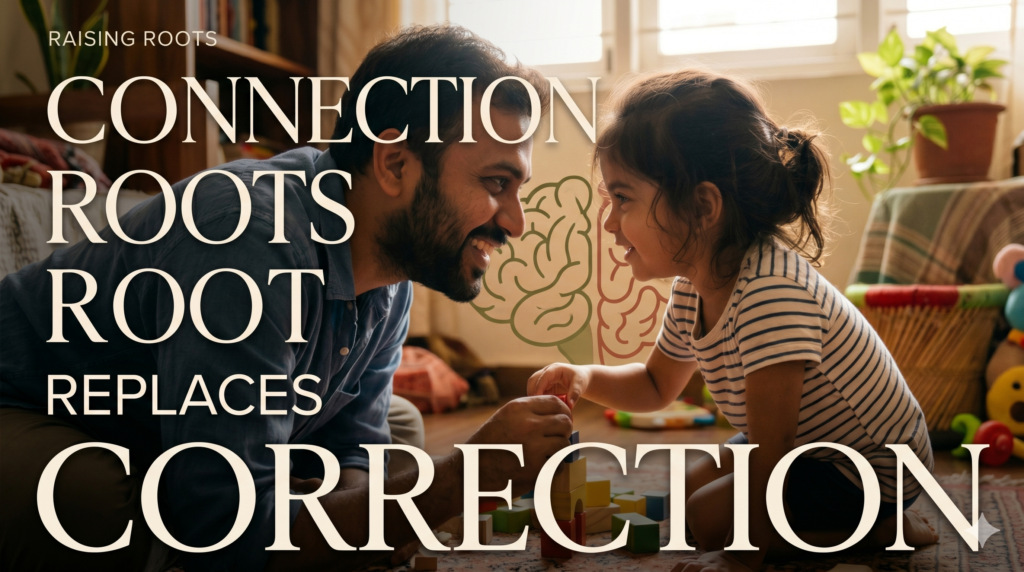
The Raising Roots Approach: Connection Before Correction
At Raising Roots, we believe in something simple yet powerful:
Parenting is not merely about changing children.
It is also about changing ourselves so we can become the calm space our children need to grow.
If we hope to raise thoughtful, resilient, and emotionally grounded children, we must move beyond high-pressure parenting and cultivate environments where curiosity can breathe.
Here are a few gentle shifts:
1. Connection Before Correction
Before correcting behaviour or pushing performance, pause and ask:
Is my child listening from trust or from fear?
Correction works best when a connection already exists.
2. Normalise Mistakes
Curiosity depends upon experimentation.
Experimentation includes mistakes.
When mistakes are met with humiliation or anger, exploration slowly disappears.
But when mistakes become opportunities for reflection, learning becomes alive.
3. Model Calmness
Children not only learn from our instructions.
They learn from our nervous systems.
If we constantly react with stress and urgency, they absorb pressure as the natural language of life.
When we become more aware of our own triggers, we create emotional safety for them to learn and grow.
Let us not raise children who merely wait for instructions.
Let us raise children who can think, question, and stand firmly in their own understanding.
Fear may produce quick obedience.
But trust nourishes lasting wisdom.
And perhaps that is the deeper calling of parenting—
not to write our children’s story for them,
but to give them roots strong enough and hearts free enough to write their own.
Growing with you,
Satish