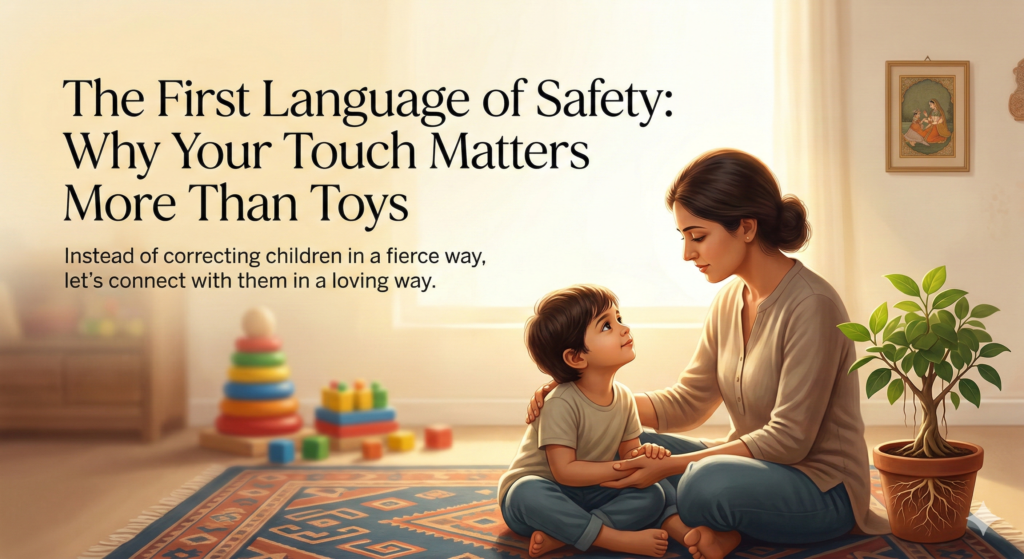

Imagine looking back at your parenting journey twenty years from now. When you see your grown child facing the world’s inevitable storms, what will give you peace? Will it be the brand of the school they attended, or the unseen armor of character you helped build within them?
In a world obsessed with giving children every luxury, we must ask ourselves a difficult question:
Are we raising comfortable children, or are we raising resilient human beings?
Are we unknowingly replacing deep connection with material convenience?
Let us step back, quiet the noise around us, and reflect on what it truly means to raise a child in today’s world.
A Sacred Process: The Sadhana of Raising a Soul
Parenting is not merely a project to be managed, nor a checklist of behavioural techniques to implement.
It is a sacred process.
In our ancient traditions, raising a child was often approached as a Sadhana—a conscious and deeply personal practice.
Parenting is not only about shaping a child; it is also about transforming ourselves.
The way we respond to stress, speak during conflict, treat others, and carry our values becomes the living curriculum our children absorb every day.
We are not simply managing routines.
We are nurturing a soul.
They Came Through Us, But Do Not Belong to Us
In this vast and beautiful creation, there is a humbling truth many parents struggle to accept:
Our children came through us, but they do not belong to us.
We do not own them.
We are not their authors.
We are their temporary guardians.
Our traditions often describe life as a continuing journey of the soul. From this perspective, parents become instruments—doorways through which unique lives enter the world.
Each child has individuality, temperament, and a path that are uniquely their own.
They are not extensions of our ego or unfinished dreams.
When we forget this truth, we can fall into subtle traps:
- over-scheduling
- over-controlling
- over-protecting
- trying to shape children into copies of ourselves
But parenting is not possession.
It is stewardship.
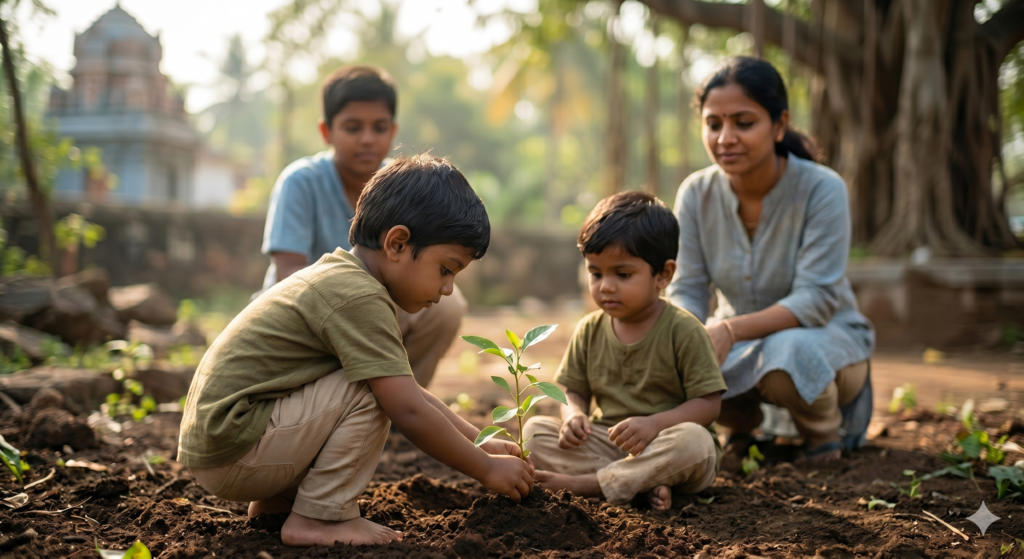
Like gardeners caring for a seed, we provide nourishment, guidance, and protection—but we cannot force the flower to become something it was never meant to be.
Beyond Comforts, Costly Living, and Elite Schools
Today, it is easy to measure parenting through what we provide materially.
We buy expensive toys.
We seek elite schools.
We try to create a comfortable, friction-free life.
There is nothing wrong with comfort or opportunity.
But material luxury cannot substitute for emotional and moral grounding.
Providing a high standard of living is a physical act.
Nurturing a high standard of character requires something deeper:
Our conscious presence.
Our true task is not merely to build a smooth road for our children.
It is to build a strong child who can walk steadily on any road.
Because one day, the world will not ask our children what they owned.
It will ask who they became.
True Education vs. Schooling Alone
Today, many of us place the entire burden of a child’s future on academics and report cards.
We quietly assume:
“If my child studies well, everything else will take care of itself.”
Education is important.
But schooling alone is only one piece of the larger picture.
Schools may train the intellect to earn a living.
But they cannot automatically teach the heart how to live.
- Patience
- Empathy
- Integrity
- Self-regulation
- Gratitude
- Courage
These are not downloaded from textbooks.
They are cultivated through relationships and daily life.
Our traditional stories often remind us of this truth. Figures like Prahlada and Dhruva are remembered not merely for their knowledge but for their inner strength, clarity, and devotion—qualities nurtured in values-centred environments.
Home is not separate from education.
Home is the first school.
Parents are the first teachers.
Character is the first curriculum.
Nurturing Strength for an Uncertain Future
The future our children will enter is uncertain.
Life will not always be comfortable, fair, or predictable.
Storms will come.
And here lies a truth we must face as parents:
The strength to face life’s challenges does not suddenly appear when hardship arrives.
It is built slowly.
Drop by drop.
Beginning in childhood.
Reading about resilience is not enough.
Concepts alone cannot save a drowning person.
The practice of swimming does.
Modern child psychology also reminds us that resilience grows not through overprotection, but through secure attachment, healthy boundaries, and opportunities to overcome manageable challenges.
This does not mean abandoning children to hardship.
It means allowing them to experience age-appropriate struggles while we remain a secure anchor beside them.
Sometimes this may mean:
- Allowing them to solve small conflicts
- Giving responsibility at home
- Teaching patience instead of instant gratification
- Letting them learn from mistakes rather than rescuing them immediately
These moments are not parenting failures.
They are resilience-building opportunities.
We must help our children become steady travellers prepared for life’s uncertain terrain.
Our traditions symbolically remind us of the power of environment and early influence. The story of Abhimanyu, for example, reflects the idea that children absorb deeply from the atmosphere, conversations, and emotional world surrounding them long before they fully understand language.
Our homes are powerful training grounds.
Every calm response during conflict…
Every moment of listening before correcting…
Every time we model patience instead of anger…
We help build their inner armor.
As the saying goes:
First connection, then correction
The Root of the Matter
Parenting today is not simply about preparing children for exams, careers, or social competition.
It is about preparing human beings.
Human beings who carry compassion.
Who can think independently?
Those who remain rooted in values while adapting to a changing world.
Perhaps the deeper question is not:
“What future can we give our children?”
But:
“What kind of human being are we helping them become?”
Parenting is not merely about raising successful children.
It is about raising rooted human beings—children who may one day stand in a difficult world with compassion, courage, and clarity.
Let us stop trying to create a perfect path for our children.
Instead, let us prepare our children for the path.
The journey does not begin with perfect parenting.
It begins with conscious parenting.
It starts with us.
It starts today.
Growing with you,
Satish