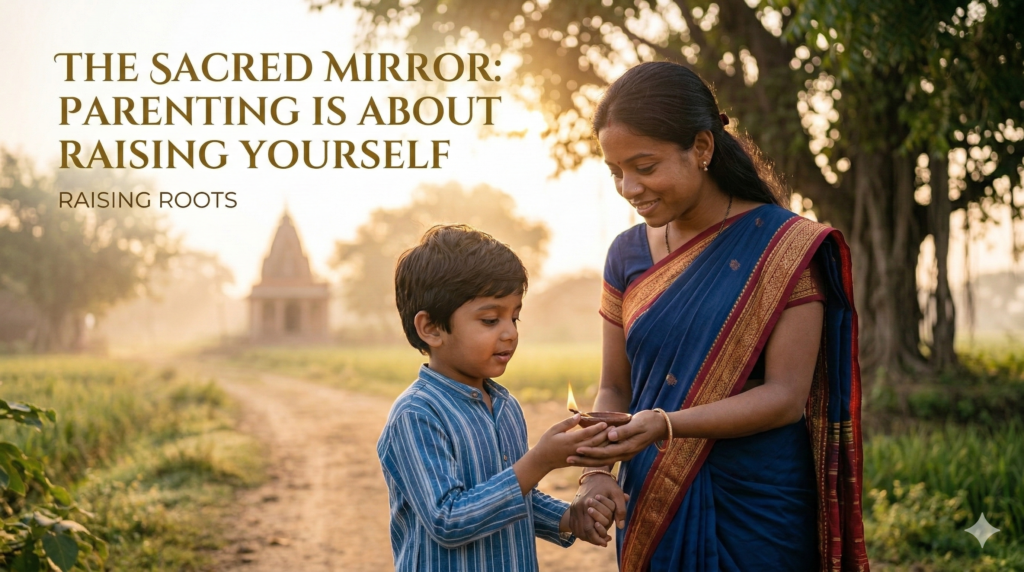


The Unspoken Geography of Childhood
Take a bowl of pure, still water.
It has no color, no fragrance, and no taste of its own. Stir in a fistful of fresh jasmine, and the water turns fragrant and sweet. Stir in raw sea salt, and it becomes sharp and bitter. Leave it open next to a hearth choked with firewood, and without a sound, it absorbs the soot.
The water makes no conscious decision to change. It simply becomes the atmosphere that surrounds it.
Our children are that water.
Think of your own child for a moment. Have you noticed how their entire presence shifts depending on where they stand? With a calm, gentle elder, they sit quietly, leaning in with soft voices. Drop that same child into a room full of noise, rushing adults, and sharp tempers, and within half an hour, they turn restless, defiant, or withdrawn. At school, they might share easily; at home, they might grip their toys like shields.
Then comes the moment that stops every parent cold: you hear your child speak to a sibling or a pet using a cutting tone, an eye roll, or a harsh inflection. You never sat down to teach them that tone. Yet it rings uncomfortably familiar.
Why does this happen?
When a child’s behavior turns difficult, our instinct is to isolate the child. We analyze their personality, label their defiance, or search for a firmer disciplinary tactic. We demand to know: “Why are you acting like this?”
In doing so, we look right past the silent architecture around them: the air they breathe inside our home every single day. A seed holds within its husk the entire design of a shade-giving banyan tree. But whether that seed grows deep roots or withers in dry dust depends on the soil, the water, the sunlight, and the wind.
Long before children understand our lectures, they absorb the emotional climate of the room.
1. What the Ancients Knew About the Power of Surroundings
Look across nature: every living being mirrors its habitat. A banyan tree struggling on a rocky cliff grows twisted and starved, fighting for every inch of moisture. That same seed, dropped into the rich riverbanks of a quiet valley, spreads wide and sends down pillars of living wood.
Our ancient traditions understood this truth with surgical clarity. The Puranas and classical lore repeatedly teach that a human being is not an isolated unit. We are shaped by our company (satsanga or dushtsanga) and the subtle impressions (samskaras) of our immediate world.
A celebrated tale preserved across classical traditions illustrates this through two birds born of the same nest.
Separated by a severe storm right after hatching, one fledgling fell near the quiet ashram of a sage. The other landed in the camp of highway robbers.
Months later, a king passed by the hermitage while hunting. The first bird perched on a branch, bowed its head, and spoke with calm warmth:
“Welcome, noble traveler. Step into the shade, rest your horse, and drink cool water. The sage will return shortly.”
Surprised by such dignity from a bird, the king rode further down the path, eventually crossing into the clearing of the thieves. The second bird fluttered to a thorny branch and screeched:
“Catch him! Strike him down! Strip his jewels, seize his horse, and leave nothing behind!”
The king was stunned. How could two birds of the same blood, plumage, and beak carry such opposite spirits? When he later met the sage, the teacher offered a simple truth:
“The bird among the thieves learned the speech of violence; the bird among the seekers learned the language of peace. Neither was born wicked or saintly. They simply spoke what their surroundings gave them.”
A young child’s mind is far more receptive than that of any bird. In the early years, their nervous systems do not filter experiences through logic. They mirror what is in front of them.
- When a child lives with steady patience and basic courtesy, their baseline becomes safety.
- When a child navigates unpredictable outbursts, sarcasm, or silent resentment, their body learns vigilance.
The home is not the background of a child’s life. It is the living ground where their character takes root.
2. We Cannot Control the World, but We Govern the Sanctuary
Every parent faces a hard truth: you cannot bubble-wrap your child’s life.
You cannot choose every peer on the school bus. You cannot control what other adults say on the playground. You cannot scrub clean every reckless influence circulating in modern society. Trying to construct an airtight barrier around a growing child is exhausting, and it leaves them unprepared for reality.
What you can build is a sanctuary within your own walls.
The world outside will challenge, test, and confuse them. The home must be the anchor that prevents the ship from drifting away. It must be the place where children can drop their defenses, speak without fear of ridicule, make mistakes, and learn how to put things right.
Notice the difference between two familiar homes responding to the exact same accident:
| The Everyday Accident | The Fear-Based Reaction | The Conscious Response | What the Child Learns |
| A child drops a ceramic bowl while carrying it to the kitchen. | Sudden shouting: “Look at what you did! Why can’t you be careful? You ruin everything you touch!” | A momentary pause. Checking safety: “Step back so you don’t cut your feet. Are you okay?” Then the practical repair: “Bowls are fragile. Let’s get the broom together and sweep this up.” | Fear-Based: “Mistakes bring anger and danger. I must hide my accidents and lie to stay safe.” Conscious: “Accidents happen, but I am safe. I am responsible for helping clean up the mess.” |
In the first home, the child learns to fear discovery. In the second, the child learns practical accountability.
Conscious parenting is not about running a home without rules, order, or standards. It is about enforcing rules without tearing down the child’s dignity. True discipline clarifies; it does not humiliate.
3. The Power of Living Truth: Why Children Watch What We Do
In Indian philosophy, the deepest instruction (Upadesha) was never just spoken words. It lived in conduct (Achara).
“Achara prathamo dharmah” — Conduct is the foundation of truth.
Picture a parent standing over a child with a raised voice: “Lower your voice! How many times have I told you not to shout in this house?”
Consider the mixed message inside that room:
- The words ask for calm.
- The body demonstrates that the person with the loudest voice wins.
Children rarely adopt our verbal lectures, but they almost never fail to copy our behavior.
They see how you treat people who cannot do anything for you. They notice whether you thank the security guard or snap at the delivery driver. They watch how you speak to your spouse after a tiring day. They see whether you make excuses when you are wrong, or own your misstep with calm dignity.
This truth should lift the burden of perfection, not add to it.
Conscious parenting does not mean never losing your cool. You will get tired. You will react hastily on difficult days. You will say things you wish you could take back.
What transforms a home’s atmosphere is what happens next: the act of repair.
Going to your child after the dust settles, sitting beside them, and saying:
“I was overwhelmed earlier, but shouting at you was wrong. I was angry, and I should have handled my big feelings better. I am sorry.”
That single interaction teaches a child more about integrity, humility, and emotional regulation than ten lectures on good behavior ever could. It shows them that being an adult does not mean being flawless—it means being responsible for your impact.
4. The Emotional Climate: What Children Feel Beneath the Words
When we think about giving our children a good upbringing, our minds naturally turn to physical needs:
- A stable roof and clean rooms.
- Healthy meals and clean water.
- Good schools, books, and enriching activities.
These matter. But they are only the physical frame (Sthula). The true life of an environment is subtle (Sukshma). It is the emotional weather that fills the rooms.
Children can sense tension long before they can name it:
- Can your child admit a failure without bracing for shame or disappointment?
- Can they disagree with you politely, or does any difference of opinion get treated as disrespect?
- When conflict happens between adults at home, is it talked through with respect, or does it hang over the family like cold silence, slammed doors, and sharp remarks?
A child living in an affluent home with every modern comfort can still feel emotionally isolated if the daily climate is cold, critical, or unpredictable. Conversely, a child raised in modest circumstances where laughter is welcome, mistakes are met with guidance, and affection is steady will grow up with strong inner grounding.
The question for a conscious parent is simple: “What does it feel like for my child to stand in the room with me?”
5. Why Early Roots Matter: The Lesson of Prahlada
The early years carry special weight because a child’s foundational view of the world is being set.
In the Srimad Bhagavatam, the story of Prahlada highlights the quiet power of early surroundings. While still in his mother Kayadhu’s womb, his father—the demon king Hiranyakashipu—was consumed by conquest and power. During those months, Kayadhu lived peacefully in the forest hermitage of Sage Narada.
In that hermitage, the air was calm. Kayadhu listened daily to reflections on compassion, self-restraint, and truth.
Prahlada was later raised in a royal palace built on pride, fear, and ruthless domination. Yet despite his father’s cruelty and the pressure of teachers demanding blind obedience to malice, Prahlada’s inner peace never cracked. His clarity was unshakeable because his earliest impressions (samskaras) had taken root in the quiet wisdom of Narada’s hermitage.
A child’s earliest impressions create their inner baseline:
- Consistent, warm attention teaches the nervous system: “I am safe. People can be trusted.”
- Predictable boundaries teach the child: “There is structure in this world. I am protected.”
- Calm guidance through big feelings teaches them: “Emotions are manageable. I can work through hardship.”
Everyday moments—putting away your phone to look your child in the eye, sitting with them through a crying spell without frustration, reading together before sleep—are not small distractions. They are the primary work. Over time, these moments become the inner voice your child will carry into adulthood.
6. Four Ways to Nourish the Soil at Home
We cannot reshape society overnight, but we can protect what happens in our living rooms. Here are four practical choices you can bring into your home starting today:
i) Protect the First and Last Thirty Minutes
The start and end of the day set an emotional anchor. Keep the first half-hour after waking and the last half-hour before bed free from screens, rushed scolding, and tension. Let your child wake up to steady presence, and let them fall asleep knowing your care for them is absolute, no matter what went wrong during the day.
ii) Create Ten Minutes of Real Listening
Spend ten minutes each day simply listening. No checking your phone, no offering unsolicited advice, and no correcting their thoughts. When children see that you can hear their world without rushing to judge it, they keep coming to you when bigger challenges arise.
iii) Anchor Your Days with Simple Rituals
Children find grounding in repeated family habits. It can be watering plants together in the morning, preparing a simple meal on weekends, or taking an evening walk. These quiet, reliable routines make a home feel stable and dependable.
iv) Mind the Invisible Influences
Be intentional about what comes into your home through screens and speakers. Constant loud television broadcasts, chaotic media, and aggressive cartoons keep young nervous systems in a state of low-level alarm. Choose quiet, thoughtful, and creative materials that allow their minds to rest and wonder.
Our goal is not to keep our children in an artificial bubble where hardship never reaches them. Our goal is to give them deep, healthy roots—so that when they step into a noisy world, they stand firm in who they are.
Look into the Mirror
Before we rush to correct our children’s behavior, we must have the honesty to examine the atmosphere we offer them.
The next time your child’s reactions push your buttons—when they whine, argue, or speak harshly—pause for five seconds before reacting. Take a slow breath, step back, and ask yourself:
- Am I seeing an echo of how I behave when I am tired or frustrated?
- Is our home an environment where a mistake is met with learning, or an arena where mistakes bring shame?
- Am I asking an eight-year-old to show the emotional balance that I, as an adult, struggle to maintain?
A sapling cannot choose its soil or its water. It simply reaches toward whatever care it receives.
Parenting is less about pushing a child into a mold and more about tending the ground so their true potential can unfold. Nourish the soil, tend the roots, and let the tree grow strong.
The Raising Roots — Growing together, one conscious choice at a time.
- Your Child Is Not Your Second Chance at Life

- The Environment We Create: The Invisible Force Shaping Our Children