
I have lost count of how many times I have heard parents say a phrase that is almost universally celebrated in our culture:
“Everything I do, I do for my children.”
It rolls off the tongue with noble conviction. We say it over late-night work emails, during commutes that steal our evenings, and when we decline moments of personal rest or quiet joy.
I work for them.
I earn for them.
I save for them.
I build a home for them.
I set aside my own happiness for them.
At its core, there is something undeniably tender about this mindset. The instinct to shelter, provide, and clear a smoother path for the next generation is one of the deepest impulses of human love. It is the quiet engine behind generations of hard-working families.
Yet, watching this pattern play out in modern homes—and examining the quiet corners of my own mind—a nagging question begins to surface:
Is a parent truly meant to live for their children? Or have we confused total self-erasure with unconditional love?
What if our children do not actually need parents who empty out their own existence to build an immaculate launchpad? What if what they genuinely need is something far more grounded: parents who live a meaningful, curious, vibrant life alongside them, and invite them into it?
There is a world of difference between living for your child and learning to live with them.
The Architecture of the Empty Fortress
Consider a pattern that has quietly become the default script of modern family life.
A father wakes before dawn and returns long after dark. He is driven by a genuine, fierce desire to provide: the best school, the safest neighborhood, supplemental tutoring, enriching vacations, and an inheritance that will insulate his children from the economic precarity he once feared.
To finance this dream, he strikes silent bargains with himself every single day. He swallows chronic exhaustion. He postpones his physical health, ignoring recurring aches and elevated stress markers. He puts his marriage on autopilot, reducing conversations with his spouse to logistical updates and school fee schedules. His old interests—reading, sketching, sports, quiet afternoon walks—are discarded as frivolous luxuries from a past life.
Whenever guilt knocks at the door of his conscience, he silences it with a single, ironclad rationalization: “It’s okay. I’m doing all of this for my children.”
Fast forward fifteen or twenty years.
The project is finished. The child grows up inside the fortress the father worked so tirelessly to construct. The child has the pedigree degree, the stable launch, the private room, the comfort, and the material head start.
Yet, when they sit across the dining table from each other as adults, an uncomfortable silence fills the room.
The child knows their father worked hard. They deeply respect the sheer grit of his labor. But they do not actually know him. He was a provider, an administrator, an authority figure, and an engine of logistics. But he was emotionally absent from the fabric of daily life.
In our collective rush to provide more, we have convinced ourselves that material provision is the ultimate synonym for love. But children do not absorb who we are through bank balances or real estate deeds.
They absorb who we are through what we embody in front of them every day.
Children Don’t Read Our Sermons; They Read Our Lives
Parenting discussions often focus on what to say: the right scripts for discipline, the best encouragement before exams, the moral parables to share at bedtime.
Yet our spoken advice is constantly measured against our lived reality.
We look our children in the eye and say:
“Be happy. Don’t take life too seriously.”
Yet they watch us startle at every notification, stew in chronic irritation, and carry the weight of everyday life with tight shoulders and clenched jaws.
We say:
“Take care of your body. Health is wealth.”
Yet they see us skip meals, survive on stress and caffeine, avoid regular movement, and treat sleep as an inconvenient interruption.
We say:
“Family is the most important thing.”
Yet they watch us bring work laptops to the dinner table and respond with half-hearted hums while staring at a screen.
We say:
“Follow your passions. Be brave. Keep learning.”
Yet they notice that we haven’t picked up a new book, practiced a creative skill, or pursued an unscripted curiosity in a decade.
Children are extraordinary observers and terrible interpreters. They rarely do what we tell them to do, but they almost never fail to imitate what we are. Our daily choices, our nervous systems, and our relationship with our own existence become the blueprint they use to construct their idea of reality.
When a child grows up watching a parent who lives in a perpetual state of martyred exhaustion, they do not think, “What an honorable sacrifice.”
Instead, they register an unspoken, anxiety-inducing conclusion:
“Adulthood is a trap. Growing up means being tired, stressed, joyless, and burdened.”
When you sacrifice your whole self in the name of your child, you inadvertently hand them an intolerable emotional burden: the responsibility of being the sole justification for your existence.
No child’s shoulders are broad enough to carry the weight of a parent’s unlived life.
The Shift: From Martyrdom to Shared Companionship
Deciding to live with your child rather than solely for them is not an invitation to neglect your responsibilities. It is not about adopting an attitude of selfish detachment or telling a young child, “I’m doing my own thing, figure it out yourself.”
It is about an intentional shift in posture. It means replacing transactional martyrdom with authentic companionship.
| Living For Your Child | Living With Your Child |
| “I work to buy you things.” | “Let me show you why this work matters to our family.” |
| Treating the child as a consumer of parental labor. | Involving the child as an active member of the household community. |
| Erasing all personal interests to maintain an over-scheduled calendar. | Inviting the child to observe and share in the pursuits that bring you alive. |
| Suppressing all struggle until it erupts as sudden frustration. | Modeling honest emotional regulation, problem-solving, and repair in real time. |
| Expecting the child to validate your sacrifices through achievement. | Honoring the child’s individuality without tying your worth to their performance. |
When you live with your child, ordinary moments stop being obstacles between tasks and become the very point of the day:
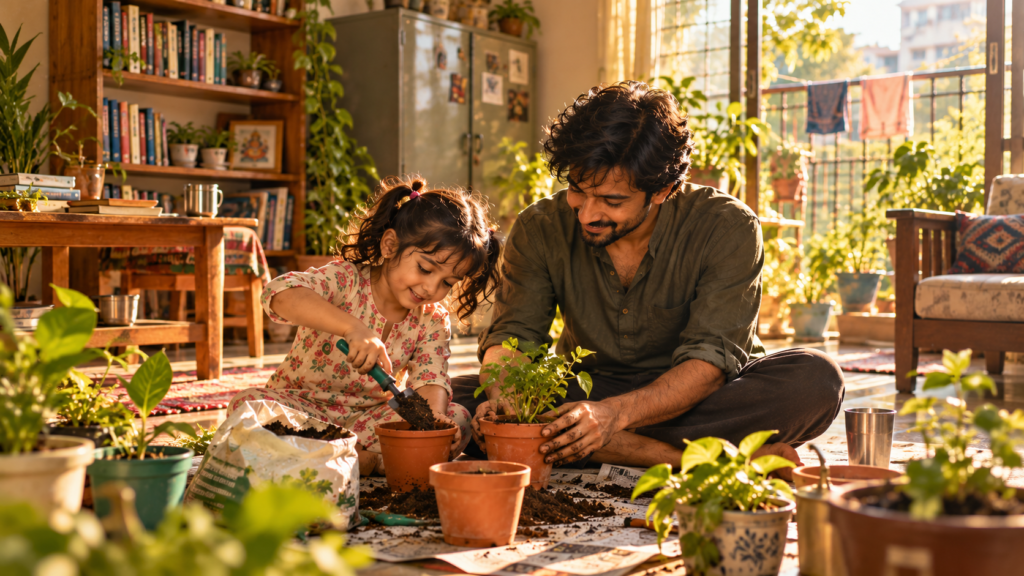
- Involve them in your everyday work: If you are folding laundry, preparing vegetables for dinner, tending to house plants, or organizing a workspace, resist the urge to banish them to a screen just to finish faster. Slow down. Hand them a cloth, a child-safe knife, or a watering can. It will take longer and it will be messier, but they learn that a home is built and sustained through shared human care, not invisible magic.
- Let them see you learn: Pick up a book, start a morning movement routine, practice an instrument, or learn a new craft. Let them witness your awkward, imperfect beginner stages. When they see a grown adult stumble, laugh off a mistake, and practice again the next morning, they learn resilience without a single lecture.
- Share unhurried space: Put away the curated weekend schedules and frantic itineraries once in a while. Go for an aimless walk after sunset. Watch a trail of ants carry a leaf across a stone path. Sit quietly on the floor while they draw, reading your own book beside them.
Presence does not require constant entertainment. It requires a settled, grounded presence that communicates: “I am here, I am at ease, and you are safe to simply exist with me.”
The Hidden Trap of the “Sacrifice” Contract
There is an uncomfortable psychological truth about absolute self-sacrifice that is rarely discussed openly: unacknowledged sacrifice almost always morphs into unspoken debt.
When a parent abandons their own growth, desires, friendships, and identity entirely for their children, that sacrifice does not simply vanish into thin air. It quietly accumulates emotional interest over the years.
Even if the parent never utters the words out loud, an internal ledger begins to keep score:
“Look at what I gave up for you. Look at how hard I worked. Look at the life I surrendered so that you could thrive.”
Then, inevitably, the child reaches an age where they assert their natural independence.
They choose a career path the parent never envisioned. They adopt perspectives the parent finds unfamiliar. They fall in love with someone unexpected, move to a distant city, or make lifestyle choices that diverge from the family script.
And suddenly, the parent feels an unbearable sting of betrayal. What feels like heartbreak is often something else: the collapse of an unspoken transaction.
Without intending to, the parent treated the child like an investment fund. The sacrifice was the capital, and the child’s obedience, achievements, and perpetual proximity were the expected returns.
Children do not ask to be brought into this world. They do not arrive with a contractual obligation to validate our choices, heal our generational regrets, or complete the unfulfilled dreams we abandoned in our youth.
They arrive as sovereign human beings entrusted to our care. Our task is not to curate their destiny, but to give them sturdy roots and the psychological safety to grow their own wings.
Expanding Your Life, Not Shrinking It
There is an old, pervasive cultural assumption that becoming a parent marks the end of your individual story—that the chapter titled “You” is permanently closed, and every subsequent chapter belongs exclusively to your offspring.
What if we inverted that perspective entirely?
What if parenting is not an act of self-erasure, but an extraordinary expansion of your life?
Before children, our perspective is often shaped by narrow, adult metrics of productivity: professional status, peer approval, social standing, and personal convenience. Over time, it is easy to become numb to the ordinary wonders of the physical world.
When you choose to live with your child, you are handed a rare invitation back into wonder.
Through their eyes, a rain puddle is not an inconvenience to step around—it is a mirror reflecting the sky and a splash waiting to happen. An afternoon bug hunt becomes a lesson in quiet patience. A bedtime question about why the stars shine turns into a shared exploration of the universe.
You do not have to spend your days frantically preparing your child for the anxieties of adulthood. Instead, you can allow their unhurried curiosity to rescue you from the cynicism of modern life.
The Real Inheritance
One day, our children will pack their bags. They will stand at the threshold of their own adult lives, looking back at the home we built for them.
When that day arrives, their memories will not be cataloged by the brand labels on their clothes, the square footage of their childhood bedrooms, or the gadgets purchased to compensate for our absence.
What they will carry in the quiet marrow of their bones is something much simpler:
- They will remember whether our eyes lit up when they walked into the room.
- They will remember how the home felt when it rained.
- They will remember that we listened to their breathless, rambling stories without reaching for a phone.
- They will remember hearing us laugh freely.
- They will remember watching us apologize after an argument, demonstrating how mature adults repair connection.
- They will remember that when the world felt overwhelming, our presence was an anchor, not an additional storm.
Do not just build a distant future for your children. Build an intentional, connected, and grounded life with them, right here in the present.
Work with purpose, but let them see you rest with equal grace.
Care for your health so they learn how to honor their own bodies.
Cultivate curiosity, creativity, and quiet passions so they understand that adulthood is an adventure to be lived, not an exhausting chore to be endured.
Because ultimately, the greatest gift you will ever give your children is not a life where you disappeared for their sake.
It is the living memory of a parent who walked beside them, embraced the messy beauty of the human experience, and showed them how to live by doing it together.
Parenting is not about disappearing for our children.
It is about raising ourselves alongside them.
If you’d like to explore this thread further, consider reading:
- Why We Are Raising Stress-Machines Instead of Children: An honest look at the modern rat race, anxiety, and why childhood needs room to breathe before it needs a crowded resume.
- The Invisible Foundation: Character is the Only Legacy: Why our children will never remember the material luxuries we bought them as deeply as the character we lived out in front of them.
- The Lost Art of Silence: How reclaiming stillness and presence helps our children grow deep, resilient roots.