
“Your child was born to explore the world. Yet before they truly learn to wonder, they’ve already been handed a timetable, a checklist, and a race they never chose to run.”
There is a question that has quietly followed me for years.
When did childhood become something to optimise instead of something to protect?
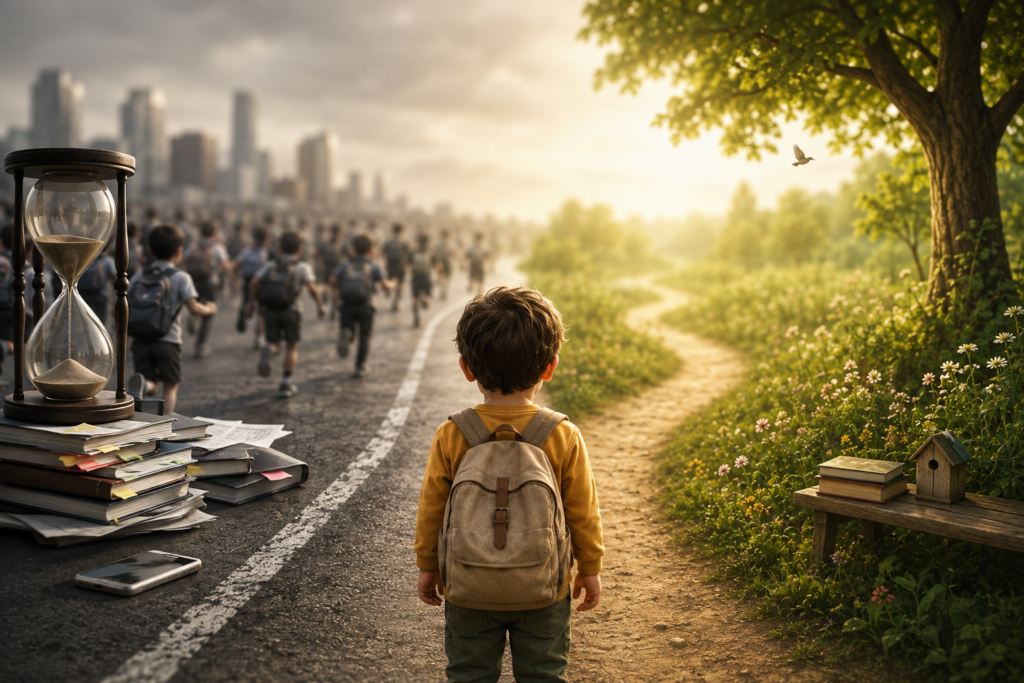
Every morning, millions of children wake up to alarms instead of birdsong.
Their days begin with rushing, schedules, homework, coaching classes, assessments, and the silent pressure to always stay ahead.
Some are barely six years old.
Yet their calendars look busier than many adults’.
As parents, we tell ourselves we’re preparing them for the future.
But now and then I wonder…
Are we preparing them for life, or preparing them to survive an endless race?
We Live in A World That Never Stops Running
Look around us.
Our phones never stop buzzing.
Emails arrive before breakfast.
Meetings stretch into evenings.
Success has become something we chase rather than something we experience.
Even our conversations have become hurried.
We proudly say we’re “busy” as though exhaustion has become a badge of honour.
The uncomfortable truth is this:
Our children are growing inside the emotional climate we create.
They watch us answer work calls during dinner.
They see us scrolling when we should be resting.
They notice our anxiety long before they understand the reasons behind it.
Children don’t simply inherit our genetics.
They inherit our pace.
Our habits.
Our worries.
Our relationship with success.
And that inheritance may shape them far more than any school curriculum ever will.
Childhood Was Never Meant to Feel Like a Corporate Career
Somewhere along the way, childhood changed.
School is no longer just a place to learn.
It has quietly become the first stage of professional competition.
Children compare marks.
Parents compare schools.
Teachers compare performance.
Social media compares everything.
Before a child discovers what fascinates them…?
They’re often asked what they want to become.
Before they discover who they are…
They’re asked how they rank.
Without meaning to, we’ve turned childhood into an interview that never ends.
We Measure Everything Except What Matters Most
Ask most parents how their child is doing.
The first answers often sound familiar.
“What grade did they get?”
“Which class are they joining?”
“How many competitions have they won?”
Rarely do we begin with different questions.
Are they kind?
Do they feel emotionally safe?
Do they laugh often?
Are they curious?
Do they enjoy learning?
Can they sit quietly with themselves?
These qualities don’t always appear on report cards.
Yet they determine whether someone lives a meaningful life.
As I explored in True Education: Are We Raising Children or Just Filling Minds?, education should awaken wisdom—not simply increase information.
Knowledge fills the mind.
Wisdom shapes the person.
The difference matters.
The Hidden Cost of Constant Achievement
Pressure doesn’t always appear dramatic.
Sometimes it arrives wearing the clothes of love.
“We only want what’s best for you.”
“Everyone else is doing it.”
“This will help you succeed.”
Most parents say these words with genuine care.
But when every hour becomes productive…
when every hobby becomes another certificate…
when every mistake becomes a crisis…
children slowly begin believing something dangerous.
“I am valuable only when I perform.”
That belief follows many people into adulthood.
It becomes perfectionism.
Burnout.
Anxiety.
Fear of failure.
The inability to rest without guilt.
The race that begins in childhood often never truly ends.
Ancient Wisdom Offers a Different Picture
Indian wisdom traditions rarely describe education as the accumulation of facts.
Instead, they speak about cultivating the whole person.
One beautiful idea is Swadharma.
Although the word carries many meanings, one way to understand it is this:
Every person has a unique nature.
Our task is not to become someone else.
Our task is to become ourselves fully.
Imagine if parenting reflected this idea.
Instead of asking,
“How can my child compete?”
we asked,
“What gifts already live inside my child?”
Instead of comparing children,
we became gardeners—helping each seed become what it was always meant to become.
The mango tree is not late because it doesn’t bloom like the jasmine.
The banyan tree isn’t failing because it grows differently from bamboo.
Nature never compares.
Only people do.
The Tree Doesn’t Grow Because We Pull Its Branches
One image returns to me again and again.
A gardener never pulls a plant upward hoping it will grow faster.
He waters the roots.
He protects the soil.
He trusts the seasons.
Growth happens naturally.
Parenting is remarkably similar.
Confidence grows from encouragement.
Curiosity grows from freedom.
Discipline grows from consistency.
Character grows from example.
None of these can be forced.
The stronger the roots become, the less we need to control the branches.
As the old proverb reminds us,
“A tree with deep roots laughs at storms.”
Perhaps our greatest responsibility isn’t producing impressive children.
Perhaps it is growing deeply rooted human beings.
Breaking the Cycle Begins at Home
Changing the world feels overwhelming.
Changing our homes is possible.
Connect Before You Correct
Children rarely remember every instruction we give them.
They never forget how we made them feel.
Before discussing grades…
Before correcting behaviour…
Before solving problems…
pause.
Sit beside them.
Listen.
Ask questions.
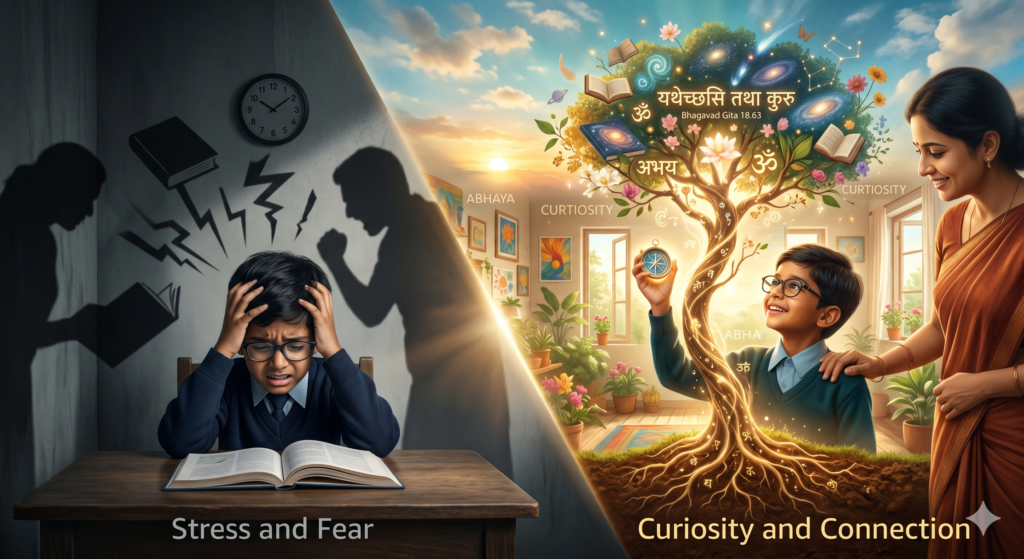
Connection creates the emotional safety that learning depends on.
A child who feels understood becomes far more open to guidance.
Protect Empty Space
Modern childhood has become overcrowded.
Lessons.
Sports.
Music.
Coding.
Homework.
More homework.
Children need something increasingly rare:
Nothing.
They need afternoons where imagination replaces instruction.
They need walks without destinations.
They need conversations without agendas.
They need silence.
In The Lost Art of Silence, I wrote that silence isn’t empty.
Silence is where the mind finally has room to breathe.
Creativity doesn’t usually appear in busy calendars.
It appears in spacious ones.
Redefine Success
Imagine asking your child every evening,
“What made you curious today?”
instead of,
“What marks did you get?”
Imagine celebrating honesty with the same enthusiasm as achievement.
Imagine praising kindness as much as intelligence.
These small shifts slowly reshape what children believe success truly means.
One day, report cards will disappear.
Character won’t.
The Childhood They Remember
Years from now, your child probably won’t remember every worksheet they completed.
They won’t remember every exam score.
But they’ll remember something else.
Whether home felt peaceful.
Whether they felt heard.
Whether mistakes were safe.
Whether laughter was common.
Whether love depended on performance.
Those memories quietly become the foundation of adulthood.
Growing Roots, Not Resumes
At Raising Roots, we believe parenting isn’t about creating extraordinary children.
It’s about raising ordinary children with extraordinary character.
Children who know how to think.
Children who know how to feel.
Children who know how to care.
Children who know who they are.
The world already has enough people racing.
What it needs are people who are grounded.
Because parenting isn’t the art of producing successful adults.
It’s the art of nurturing deep roots from which a meaningful life can grow.
And perhaps that’s the greatest gift we can ever give our children.
A Question for Every Parent
When your child is thirty years old, what do you hope they’ll thank you for?
Not the classes.
Not the trophies.
Not the rankings.
But the values.
The memories.
The peace.
The confidence to become themselves fully.
I’d love to hear your thoughts.
Leave a comment below, and if this article spoke to you, share it with another parent who believes childhood deserves to be protected—not hurried.